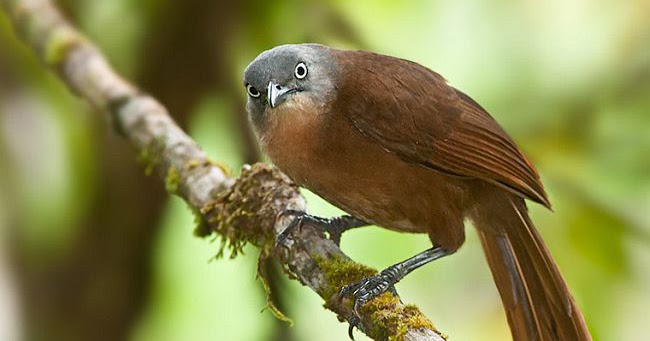
Ashy Headed Laughing Thrush - හිස අළු දෙමලිච්චා
The Ashy-Headed Laughingthrush is a rare and fascinating bird species
endemic to Sri Lanka. It belongs to the Leiothrichidae family and is
well known for its sociable nature and unique laughing calls. This
species is mainly found in lowland and submontane rainforests, where it
thrives in dense undergrowth and bamboo thickets. It is often seen in
small flocks, moving actively through the foliage while foraging for
food.
The Ashy-Headed Laughingthrush is a medium-sized bird, measuring
approximately 22–25 cm in length. It has a distinct ashy-gray head,
which contrasts with its olive-brown upperparts and paler underparts. A
dark eye-stripe runs from the base of its curved, strong beak to the
sides of its head, giving it a striking appearance. Its long, slightly
graduated tail helps it maintain balance while hopping between
branches..
The Ashy-Headed Laughingthrush is omnivorous, feeding on a variety of
insects, small fruits, berries, and seeds. It often forages on the
forest floor, flipping leaves and twigs to find hidden prey.
Occasionally, it follows mixed-species feeding flocks, joining other
birds in search of food. This species is primarily found in the
southwestern and central regions of Sri Lanka, including well-known
rainforest reserves such as:Sinharaja Forest Reserve, Kitulgala
Rainforest, Morapitiya Forest, and Kanneliya Forest Reserve.
The Ashy-Headed Laughingthrush prefers dense forests with thick
undergrowth, often near water sources. It thrives in humid environments
and is less commonly seen in secondary forests or human-modified
landscapes.
This bird is highly social, moving in groups of 6–10 individuals. It is
extremely vocal, producing a variety of chattering, whistling, and
laughing-like calls, which help the flock communicate while foraging.
The bird's call is one of the most recognizable sounds in Sri Lanka’s
rainforests. Although it is an active flier, the Ashy-Headed
Laughingthrush prefers to move by hopping between branches and
undergrowth. It is often seen playing, preening each other, and engaging
in cooperative behaviors within its flock.
Due to deforestation, habitat fragmentation, and climate change, the
Ashy-Headed Laughingthrush is classified as Near Threatened (NT) on the
IUCN Red List. The biggest threat to its survival is the destruction of
Sri Lanka’s rainforests for agriculture, logging, and human settlements.
Several conservation programs focus on protecting Sinharaja and other
rainforests, which are crucial for the survival of this species.
Strengthening these conservation efforts is essential to ensure that the
Ashy-Headed Laughingthrush continues to thrive in the wild.
The Ashy-Headed Laughingthrush is an important symbol of Sri Lanka’s
rich avian biodiversity. Its fascinating social behavior, unique calls,
and dependence on dense rainforests make it a treasured species among
birdwatchers and conservationists. Preserving its natural habitat is
critical for ensuring that future generations can continue to admire
this remarkable bird.