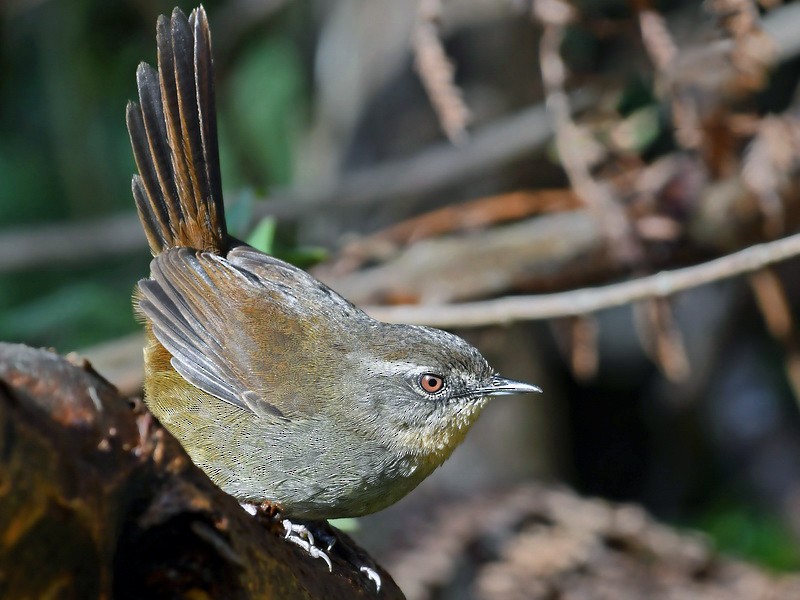
Ceylon Bush-Warbler - කවුඩා
The Ceylon Bush-Warbler, scientifically known as Elaphrornis palliseri, is a small, elusive bird endemic to Sri Lanka. It belongs to the Locustellidae family and is mainly found in the montane forests of the central highlands. This species is often heard rather than seen due to its secretive nature and preference for dense undergrowth. It is a prized sighting for birdwatchers visiting Sri Lanka’s highland forests, especially in locations such as Horton Plains, Hakgala, and the Knuckles Mountain Range.
The Ceylon Bush-Warbler is a small, plump bird with a length of around 14–15 cm. It has a rounded body, short tail, and strong legs, adapted for its ground-dwelling lifestyle. The bird’s plumage is primarily olive-brown, blending well with the forest floor. It has a darker brown head, a faint pale eyebrow (supercilium), and a slightly curved bill suited for foraging in leaf litter. Unlike more colorful birds, its subtle earthy tones help it remain camouflaged in its dense forest habitat.
The Ceylon Bush-Warbler is strictly confined to Sri Lanka’s montane forests, typically above 1,200 meters (3,900 feet). It thrives in cloud forests, dense bamboo thickets, and moss-covered undergrowth, often staying close to damp areas where insects are abundant
The Ceylon Bush-Warbler is primarily insectivorous, feeding on small insects, spiders, larvae, and worms found in leaf litter. It uses its strong legs and slightly curved beak to scratch and probe the forest floor. Occasionally, it may also consume small berries when insect food is scarce.
This species is highly territorial and vocal, with a sharp, whistling song that sounds like "whee-chee-whee". The male and female often sing in duets, especially during the breeding season. Despite its loud calls, the bird remains well-hidden, making it difficult to spot.
The breeding season of the Ceylon Bush-Warbler occurs between April and August, with peak activity in May and June. The nest is a cup-shaped structure made of moss, grass, and leaves, carefully hidden within dense undergrowth. The female lays 2 to 3 eggs, which are incubated for about two weeks. Both parents take part in feeding the chicks, ensuring their survival in the challenging montane environment.
The Ceylon Bush-Warbler is classified as Near Threatened (NT) by the IUCN, primarily due to habitat destruction. The deforestation of Sri Lanka’s montane forests for agriculture, tea plantations, and human settlements threatens this species. Climate change also poses a risk, as rising temperatures may alter the delicate ecosystems of highland forests. Conservation efforts such as protected reserves, reforestation projects, and eco-tourism initiatives play a crucial role in safeguarding this unique bird.
The Ceylon Bush-Warbler is a remarkable example of Sri Lanka’s rich endemic birdlife, thriving in the cool, misty forests of the central highlands. Despite being difficult to spot, its melodious calls and secretive nature make it an exciting challenge for birdwatchers. Conservation efforts are crucial to ensure the survival of this species, as habitat loss continues to threaten its existence. Protecting Sri Lanka’s montane forests is essential for preserving this unique and irreplaceable bird for future