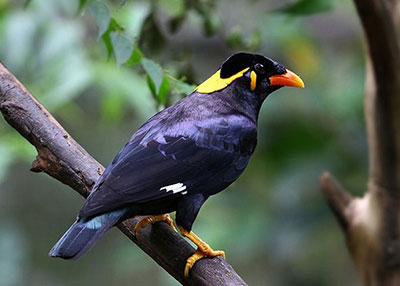
Ceylon Hill Mynas - සැළලිහිණියා
The Ceylon Hill Myna (Gracula ptilogenys), also known as the Sri Lanka Hill Myna, is a striking and vocal bird endemic to Sri Lanka. Belonging to the starling family Sturnidae, it is a close relative of the more widely known Common Hill Myna (Gracula religiosa), but it is unique to the forests of Sri Lanka. This species is primarily found in the wet zone forests, particularly in areas with dense vegetation and high humidity, such as the Sinharaja Forest Reserve, Horton Plains, Knuckles Mountain Range, and the central hills. Unlike its widespread relatives, the Ceylon Hill Myna prefers elevated forests, making it more elusive and less commonly seen than other myna species.
One of the most distinctive features of the Ceylon Hill Myna is its glossy black plumage, which has a beautiful sheen that reflects shades of purple and green under sunlight. Its bright orange-yellow wattles on the sides of its head, just behind the eyes, are a key identifying characteristic and are more prominent than those of other hill mynas. These fleshy wattles are thought to play a role in communication and mate attraction. Its beak is a vibrant shade of orange-red, contrasting sharply with its dark feathers, while its legs and feet are yellow, giving it a colorful and distinctive appearance. These adaptations make it one of the most visually appealing birds in Sri Lanka’s forests.
The Ceylon Hill Myna is best known for its exceptional vocal abilities. It is a highly intelligent and social bird, capable of producing an astonishing range of whistles, squawks, and even human-like calls. In the wild, these birds use their vocal skills to communicate with their flock, attract mates, and warn others of potential danger. Their ability to mimic sounds, including other bird calls and even human speech, has made them highly sought after in the pet trade, leading to concerns about illegal capture and population decline.
In terms of behavior, Ceylon Hill Mynas are usually found in pairs or small flocks, actively moving through the canopy in search of food. They are omnivorous, with a diet that primarily consists of fruits, berries, nectar, and insects. Their strong, curved beak allows them to pluck fruits with precision, making them important seed dispersers in their ecosystem. By consuming fruits and later excreting the seeds in different locations, they play a crucial role in maintaining the biodiversity of Sri Lanka’s rainforests. They also feed on small invertebrates, including beetles, caterpillars, and other insects, providing a balance in their diet.
During the breeding season, which usually occurs between March and August, Ceylon Hill Mynas engage in elaborate courtship displays, involving vocal duets, head movements, and beak touching. These behaviors strengthen pair bonds and help them select the most compatible mates. The birds nest in tree cavities, preferring tall trees with natural hollows. The female lays 2-3 eggs, which are incubated by both parents for about 14-18 days. Once the chicks hatch, they are fed regurgitated food until they are strong enough to leave the nest. The young birds develop quickly, learning to vocalize and interact with their surroundings at an early stage.
Despite their adaptability, Ceylon Hill Mynas face several threats, primarily due to habitat destruction, deforestation, and illegal pet trade. As forests are cleared for agriculture, plantations, and urban expansion, these birds lose their natural nesting sites and food sources. Additionally, their remarkable ability to mimic human speech has made them highly desirable as pets, leading to excessive trapping in some regions. Conservation efforts are crucial to ensuring their long-term survival. Sri Lanka’s protected forest reserves play a significant role in providing safe habitats, and awareness campaigns have been launched to discourage illegal capture.
Overall, the Ceylon Hill Myna is a remarkable and charismatic bird, both visually stunning and vocally gifted. Its role as a seed disperser and insect controller makes it an important part of Sri Lanka’s forest ecosystem. Conservation efforts must continue to protect this species, ensuring that future generations can enjoy the presence of this iconic bird in Sri Lanka’s lush highland forests.