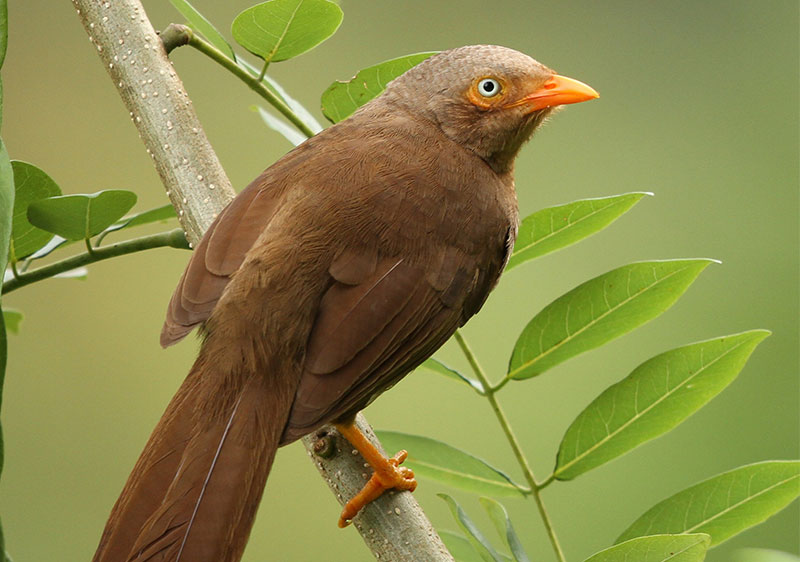
Ceylon Rufous Babble - දෙමළිච්චා
The Ceylon Rufous Babbler (Argya rufescens), also known as the Sri Lanka Rufous Babbler, is a striking and social bird endemic to Sri Lanka. It belongs to the Leiothrichidae family, which includes many species of laughing thrushes and babblers known for their active and noisy behavior. This bird is commonly found in the wet zone forests of Sri Lanka, especially in dense lowland rainforests and montane forests, such as the Sinharaja Forest Reserve, Kanneliya Forest, and the Knuckles Mountain Range. Unlike some babblers that prefer scrubland or open woodlands, the Ceylon Rufous Babbler thrives in thick, humid forests where it can move in flocks and forage for food.
The Ceylon Rufous Babbler has a rich reddish-brown (rufous) plumage, which gives it its name. This distinctive coloration helps it blend into the forest undergrowth, providing camouflage from predators. Its wings and tail feathers are a slightly darker shade of brown, adding to its elegant yet earthy appearance. It has a pale yellow or creamy-white throat and a slightly darker head, giving it a subtle but attractive contrast. Its eyes are dark, with a sharp gaze, and its curved beak is well-adapted for foraging. The legs are strong and sturdy, allowing it to move effortlessly through the forest floor while searching for food.
One of the most remarkable features of the Ceylon Rufous Babbler is its highly social nature. It is almost never seen alone, preferring to move in tight-knit flocks of 6 to 12 individuals. These flocks are highly cooperative, with members constantly communicating through a series of chattering calls, whistles, and trills. Their vocal nature makes them one of the most easily recognizable bird species in Sri Lanka’s forests. This continuous communication helps them stay connected, warn of predators, and coordinate foraging activities.
In terms of diet, the Ceylon Rufous Babbler is an omnivorous bird, feeding on a variety of insects, small invertebrates, fruits, and seeds. It forages both on the forest floor and in the lower canopy, using its sharp beak to dig through leaf litter in search of hidden prey. It also plays an important role in seed dispersal, as it consumes various berries and fruits, helping to regenerate plant life in its habitat. The flocking behavior of this bird allows them to search for food more efficiently, as more eyes mean a better chance of spotting insects or fruiting trees.
The breeding season for the Ceylon Rufous Babbler typically falls between March and June, coinciding with Sri Lanka’s rainy season when food is abundant. These birds build cup-shaped nests using twigs, leaves, and moss, usually hidden within dense vegetation or inside tree hollows. The female lays 2-3 eggs, and both parents take part in incubation and feeding the chicks. Interestingly, other flock members may also help in raising the young, a behavior known as cooperative breeding, which increases the survival chances of the chicks. This communal care system strengthens their social bonds and ensures that the flock remains close-knit.
Despite their adaptability, Ceylon Rufous Babblers face several threats, primarily due to habitat destruction and deforestation. As Sri Lanka’s rainforests are cleared for agriculture, plantations, and urban development, these birds are losing their natural habitat. Although they are not currently classified as endangered, continued destruction of their ecosystem could pose a serious risk in the future. Fortunately, protected areas such as the Sinharaja Forest Reserve provide a safe haven for these birds. Conservation efforts, including reforestation and awareness campaigns, are essential to ensure the survival of this unique and social species.
Overall, the Ceylon Rufous Babbler is a beautiful, intelligent, and highly social bird that plays a vital role in Sri Lanka’s forest ecosystem. Its gregarious nature, melodious calls, and cooperative behavior make it a fascinating species to observe. Conservation of Sri Lanka’s rainforests is crucial to preserving not only the Ceylon Rufous Babbler but also the countless other endemic species that call these forests home.