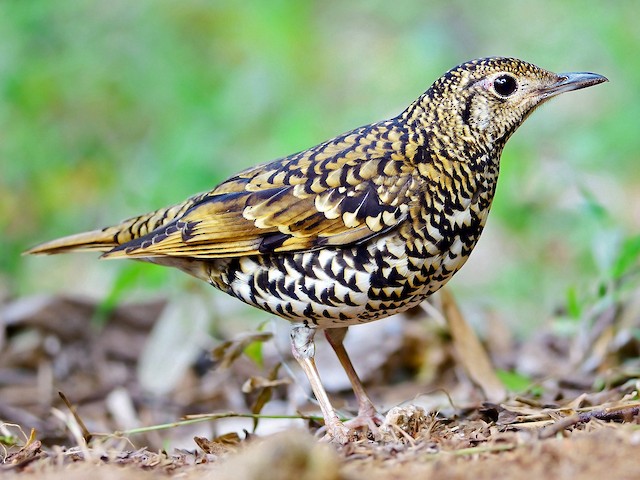
Ceylon Scaly Thrushs -ලංකා පෙති ගෝමර වන අවිච්චියා
The Ceylon Scaly Thrush (Zoothera imbricata), also known as the Sri Lanka Scaly Thrush, is a secretive and well-camouflaged bird endemic to Sri Lanka. This elusive species belongs to the Turdidae family, which includes other thrushes and ground-dwelling songbirds. It was once considered a subspecies of the Scaly Thrush (Zoothera dauma), but it has since been classified as a distinct species due to its unique characteristics and restricted range. The Ceylon Scaly Thrush is primarily found in the montane and lowland rainforests of Sri Lanka, particularly in areas like Horton Plains, Sinharaja Forest Reserve, and the Knuckles Mountain Range.
One of the most striking features of the Ceylon Scaly Thrush is its intricate feather pattern, which resembles the scales of a reptile. Its plumage is a mix of brown, black, and buff colors, with each feather featuring a dark, scalloped edge, giving it a beautifully textured appearance. This scaly pattern provides excellent camouflage, allowing the bird to blend seamlessly into the leaf litter of the forest floor. This cryptic coloration makes it extremely difficult to spot, even for experienced birdwatchers. It is often noticed only when it suddenly flies away after being disturbed.
Unlike many other thrush species that prefer perching on branches, the Ceylon Scaly Thrush is a ground-dwelling bird. It spends most of its time foraging in the leaf litter, using its sharp, slightly curved beak to probe the soil and overturn leaves in search of food. Its diet consists mainly of insects, earthworms, small invertebrates, and occasionally fallen fruits. The bird is usually solitary or found in pairs, and it moves cautiously through the undergrowth, relying on its camouflage to stay hidden from predators.
The Ceylon Scaly Thrush is also known for its soft, melodious calls, which are often heard early in the morning or late in the evening. Unlike some other thrushes with loud and continuous songs, this bird's call is subtle and flute-like, blending harmoniously with the forest’s natural sounds. During the breeding season, which occurs between February and May, males become more vocal, using their calls to attract mates and establish territory.
The nesting habits of the Ceylon Scaly Thrush are relatively unknown due to its elusive nature. However, like other thrushes, it is believed to build well-hidden nests in tree hollows, dense shrubs, or on the ground, made of twigs, leaves, and moss. The female typically lays 2-3 eggs, and both parents take turns in incubation and feeding the chicks.
Despite being well-adapted to forest life, the Ceylon Scaly Thrush faces several threats, primarily due to habitat loss and deforestation. The destruction of Sri Lanka’s montane and lowland forests for agriculture, logging, and human settlements has significantly reduced its habitat. Additionally, since the bird is highly sensitive to disturbances, increasing human activity in forested areas further impacts its population.
Conservation efforts are crucial to protect the Ceylon Scaly Thrush and its fragile ecosystem. Fortunately, many of Sri Lanka’s protected forests, such as Horton Plains National Park and Sinharaja Forest Reserve, provide safe habitats for this rare species. Continued efforts in forest conservation, habitat restoration, and awareness programs will help ensure the survival of this beautiful and mysterious bird for future generations.