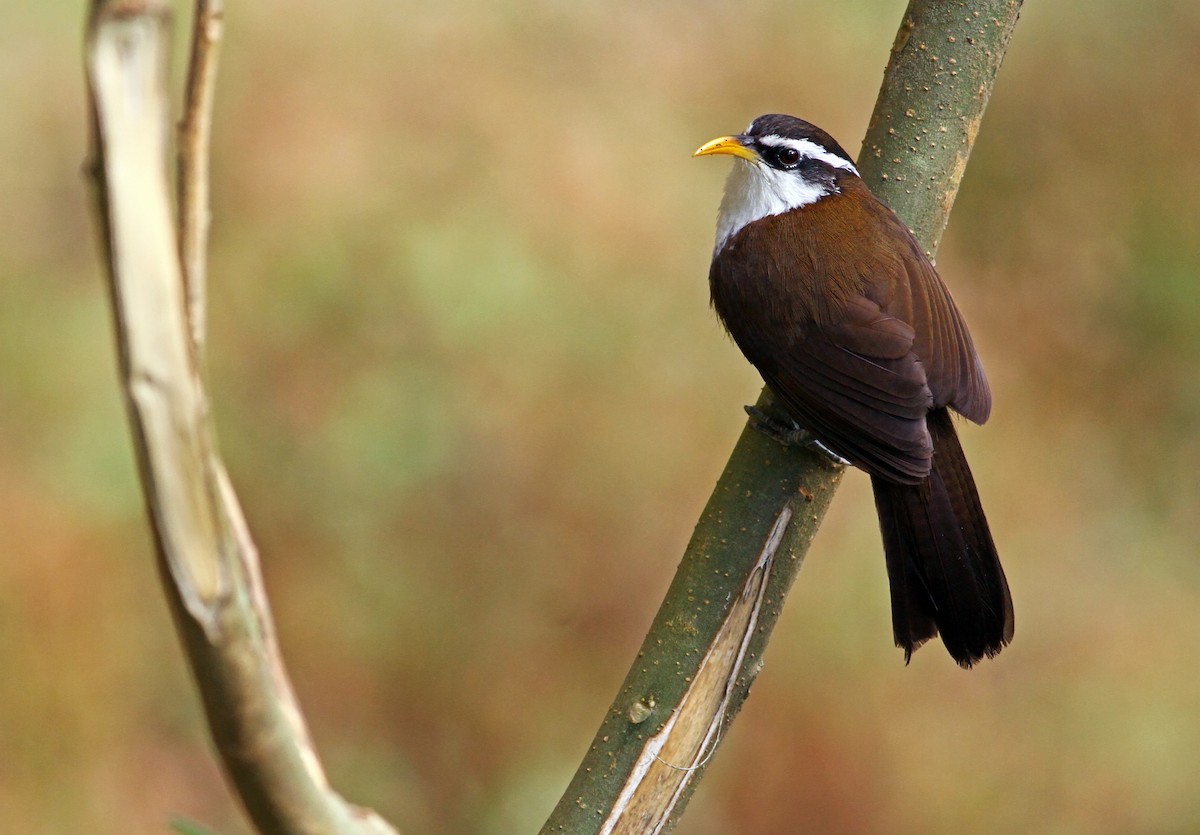
Ceylon Scimitar-Babbler-ශ්රි ලංකා දෑකැති දෙමළිච්චා
The Ceylon Scimitar-Babbler (Pomatorhinus melanurus), also known as the Sri Lanka Scimitar-Babbler, is an endemic bird species found exclusively in the forests of Sri Lanka. It belongs to the Timaliidae family, a group of birds known as babblers, which are characterized by their sociable nature and melodious calls. This bird is named after its distinctive long, curved beak, which resembles a scimitar, a type of curved sword historically used in South Asia and the Middle East. The Ceylon Scimitar-Babbler is a medium-sized bird with rich brown plumage, a white throat, a bold white eyebrow stripe, and a striking yellowish-orange beak. This unique appearance, combined with its secretive behavior, makes it an intriguing species for birdwatchers and ornithologists.
The Ceylon Scimitar-Babbler is a forest-dwelling species that primarily inhabits lowland and montane rainforests, though it can sometimes be found in well-wooded areas and secondary forests. It is most commonly seen in protected forest reserves such as the Sinharaja Forest Reserve, Horton Plains National Park, and the Knuckles Mountain Range. These forests provide the dense undergrowth and thick foliage that the bird relies on for food and shelter.
This species prefers humid, tropical environments, where there is plenty of leaf litter and decaying wood—ideal conditions for finding its primary food sources, which include insects, spiders, larvae, small reptiles, and occasionally fruits. The Ceylon Scimitar-Babbler is often found in pairs or small family groups, moving through the undergrowth in search of food. Despite its distinctive appearance, it is often difficult to spot due to its preference for dense vegetation and its shy nature.
The Ceylon Scimitar-Babbler has several distinctive physical traits that set it apart from other babblers. Its most notable feature is its long, downward-curving beak, which it uses to probe into tree bark, dead leaves, and loose soil in search of hidden prey. The beak is bright yellow or orange, creating a striking contrast with the bird’s predominantly brown plumage.
Its body is covered in warm brown feathers, with a slightly darker brown back and wings. A prominent white supercilium (eyebrow stripe) runs above the eye, giving the bird an expressive look. The throat and upper chest are white, gradually blending into the rich brown of the rest of its body. The bird’s legs are strong and well-adapted for gripping branches, as it frequently moves through the undergrowth and clings to tree trunks while foraging.
The Ceylon Scimitar-Babbler is an active forager, spending much of its time searching for food in the forest undergrowth. Unlike some birds that rely on visual cues to locate prey, this babbler primarily uses its curved beak to probe and dig into bark, rotting logs, and leaf litter. It has been observed flipping over leaves and breaking apart decaying wood to uncover insects, spiders, worms, and even small frogs or lizards.
Though it is not a particularly social species, it is often found in pairs or small groups, especially during the breeding season. These birds communicate with each other using a variety of whistles, trills, and repetitive calls, which help them maintain contact while foraging in dense vegetation. Their calls are loud and melodious, making them easier to hear than to see.
The breeding season of the Ceylon Scimitar-Babbler typically occurs between March and August, although some nesting activity has been recorded outside this period. Like many other babblers, this species is known for its secretive nesting behavior, building its nests in dense foliage, tree hollows, or within thick undergrowth to protect them from predators.
The nest itself is usually constructed from twigs, dry leaves, moss, and root fibers, carefully woven into a cup-shaped or domed structure. The female lays between 2 to 4 eggs, which are white or pale bluish in color. Both male and female birds participate in incubating the eggs and feeding the chicks once they hatch. The young birds remain in the nest for several weeks, being fed a steady diet of insects and small invertebrates before they become independent.
One of the most recognizable features of the Ceylon Scimitar-Babbler is its distinctive vocalizations. It has a variety of loud, melodious whistles and repetitive calls, which are often heard echoing through the forest. These calls serve multiple purposes, including territorial defense, mate attraction, and communication between pairs or family groups.
Unlike some songbirds that have complex, varied songs, the Ceylon Scimitar-Babbler produces clear, repetitive whistles, often described as a series of "whee-whee-whee" or "chu-chu-chu" sounds. These vocalizations help birdwatchers locate the species, even when the birds themselves remain hidden in dense vegetation.
The Ceylon Scimitar-Babbler is classified as a species of Least Concern (LC) by the International Union for Conservation of Nature (IUCN). However, like many forest-dependent species, it faces several threats due to habitat loss and deforestation. The biggest threat comes from deforestation for agriculture, logging, and human settlement expansion, which has led to the fragmentation of Sri Lanka’s rainforests.
Although this species has adapted to some secondary forests and well-wooded areas, it depends on dense undergrowth for foraging and nesting. The loss of these critical habitats could reduce population numbers over time. Additionally, climate change and increased disturbance from human activities in protected areas also pose potential risks.
Several conservation initiatives have been put in place to protect Sri Lanka’s endemic birds, including the Ceylon Scimitar-Babbler. Many of Sri Lanka’s rainforests are now protected as national parks, reserves, and UNESCO World Heritage Sites, which provide crucial safe havens for this species. Conservation organizations and birdwatching groups are also working to raise awareness about the importance of preserving Sri Lanka’s unique biodiversity.
The Ceylon Scimitar-Babbler is a fascinating and unique bird that plays an important role in Sri Lanka’s forest ecosystem. Its specialized beak, cryptic plumage, and secretive habits make it an intriguing species to study and observe. While it is currently not endangered, ongoing habitat destruction remains a major concern, highlighting the need for continued conservation efforts. Protecting Sri Lanka’s rainforests and promoting sustainable development will ensure that future generations can continue to admire this remarkable bird in the wild.