Crimson backed Flameback - රත්පිට මහ-කෑරලා

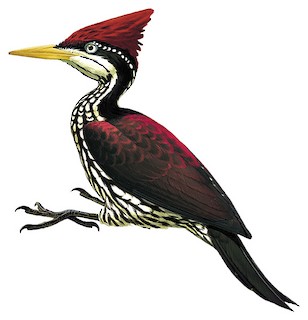
The Crimson-backed Flameback (Chrysocolaptes stricklandi) is a strikingly beautiful woodpecker species endemic to Sri Lanka. It belongs to the Picidae family, which includes various woodpecker species known for their characteristic drumming behavior and tree-climbing abilities. This bird is often mistaken for the Greater Flameback (Chrysocolaptes guttacristatus), a closely related species found in South and Southeast Asia, but the Crimson-backed Flameback is unique to Sri Lanka. This makes it one of the country’s most iconic and sought-after bird species, especially among birdwatchers and wildlife enthusiasts. The Crimson-backed Flameback is a medium to large-sized woodpecker, measuring around 28–32 cm in length. It is instantly recognizable by its vibrant crimson-red back, which contrasts sharply with its golden-yellow wings. The head and neck are mostly black with white streaks, while its underparts are a pale buff or whitish color. Males have a bright red crown, while females possess a black crown with white speckles, making it easy to distinguish between the sexes. Like most woodpeckers, this species has a strong, chisel-like beak, which it uses to peck into tree bark in search of insects and larvae. Its zygodactyl feet (two toes facing forward and two backward) allow it to grip tree trunks securely as it moves vertically along branches.
Breeding season typically occurs between February and June, with peak nesting activity observed in March and April. The Crimson-backed Flameback excavates a nesting hole in a tree trunk, where the female lays two to three white eggs. Both parents take turns incubating the eggs and feeding the chicks, demonstrating strong parental care. After about two to three weeks, the young birds fledge but remain dependent on their parents for some time before becoming fully independent. Despite being relatively common in Sri Lanka, the Crimson-backed Flameback faces threats from deforestation, habitat destruction, and logging activities. Loss of large trees due to urbanization and agricultural expansion reduces the availability of suitable nesting sites. However, due to its adaptability, this species is often seen in tea and coconut plantations, rubber estates, and secondary forests, suggesting that it can thrive in modified habitats. The International Union for Conservation of Nature (IUCN) currently classifies it as a species of Least Concern (LC), but continued conservation efforts are necessary to ensure its long-term survival.

The Crimson-backed Flameback plays a crucial ecological role as a natural pest controller, helping to regulate insect populations within its habitat. Additionally, by drilling holes in trees, it creates nesting cavities that can later be used by other species such as small owls, parakeets, and squirrels. Its bold colors, loud calls, and acrobatic tree-climbing behavior make it a fascinating species to observe, drawing the attention of ornithologists and wildlife photographers alike. In conclusion, the Crimson-backed Flameback is one of Sri Lanka’s most distinctive and ecologically significant birds. Its presence in forests and home gardens highlights the importance of preserving natural habitats and maintaining biodiversity. Conservation efforts such as reforestation projects, protection of old-growth trees, and reducing habitat fragmentation are essential to safeguarding this stunning woodpecker species for future generations.