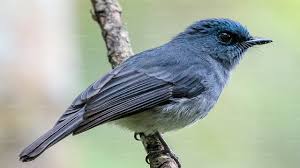
Dusky-blue Flycatcher-ශ්රී ලංකා අනු-මැසිමාරා | නිල් මාරාවා
Dusky-blue Flycatcher is a small, insectivorous bird belonging to the
Muscicapidae family, commonly found in tropical and subtropical forests of
sub-Saharan Africa. With a length of about 12–14 cm, it has a slender
body, medium-length tail, and a sharp beak adapted for capturing insects.
As its name suggests, this species exhibits a dusky-blue coloration,
particularly on its upper parts, while the underparts are a lighter shade
of gray or pale blue. Its round, dark eyes provide excellent vision for
detecting movement, and its agile flight makes it an efficient hunter.
Primarily inhabiting dense woodlands, moist lowland forests, and riverine
areas, the Dusky-blue Flycatcher thrives at elevations ranging from sea
level to about 1,800 meters. It is not a long-distance migrant, but some
populations show seasonal movements in search of food. This bird is an
expert insect hunter, using a "sallying" technique to perch and swiftly
snatch prey from the air. Its diet mainly consists of flies, beetles,
moths, ants, and small spiders, playing a crucial role in controlling
insect populations within its habitat.
Breeding occurs mainly during the rainy season when food is abundant.
Males attract females through melodious whistles and trills, which also
serve to establish and defend territories. Nesting sites are typically
located in tree hollows or dense shrubbery, with nests constructed from
twigs, moss, and spider silk. A typical clutch consists of 2–4 eggs,
incubated for about 12–15 days. Once hatched, the chicks are fed by both
parents and fledge within two to three weeks, though they remain dependent
on their parents for a short period.
Despite its relatively stable population, the Dusky-blue Flycatcher faces
threats from habitat loss due to deforestation, climate change, and
predation by birds of prey, snakes, and small mammals. Near human
settlements, domestic cats also pose a danger. However, the species is
currently classified as Least Concern by the IUCN, meaning it is not
immediately at risk of extinction. Conservation efforts, including the
protection of forests and reforestation projects, are essential in
maintaining its population.
This bird is not only ecologically important as a natural pest controller
but also attracts birdwatchers and ornithologists due to its striking
appearance and agile flight. Interestingly, it sometimes follows monkey
troops, catching insects disturbed by their movement through the forest.
Unlike some flycatchers that prefer open areas, the Dusky-blue Flycatcher
thrives in dense vegetation, where it skillfully maneuvers through
branches in search of food.
A vital part of its ecosystem, the Dusky-blue Flycatcher continues to
adapt to changing environments, but conservation efforts remain crucial in
ensuring its long-term survival. Preserving the forests it depends on will
help maintain biodiversity and the delicate balance of insect populations
in its natural habitat.