Legge’s Flowerpecker - ශ්රී ලංකා පිළිලිච්චා
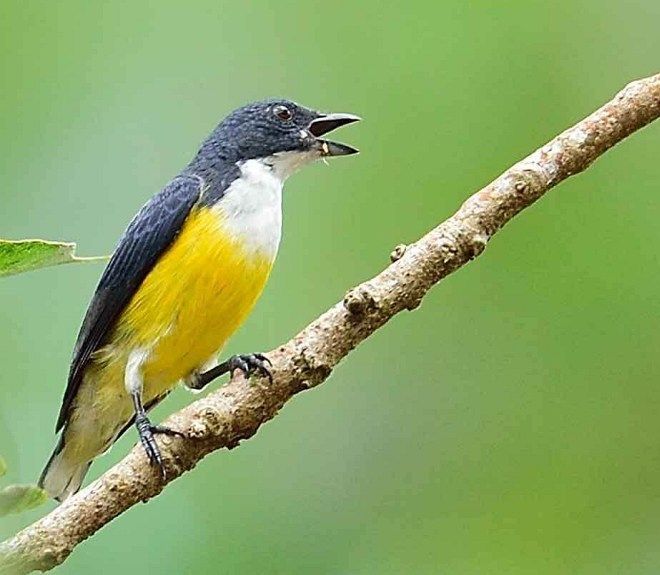
The Legge’s Flowerpecker (Dicaeum vincens) is a small yet vibrant bird
species endemic to Sri Lanka, primarily found in the island's wet zone,
dry zone forests, and home gardens with dense vegetation. Named after the
British ornithologist William Vincent Legge, this bird belongs to the
Dicaeidae family, commonly known as flowerpeckers, which are tiny,
nectar-feeding birds playing a vital role in forest ecosystems through
pollination and seed dispersal. Measuring about 8 cm in length, Legge’s
Flowerpecker is one of the smallest birds in Sri Lanka, often mistaken for
a flying insect due to its swift, darting movements among flowers. Its
plumage is predominantly dark olive-green on the upper parts, while its
underparts are a pale yellowish or buff-white color. A distinct whitish
throat and belly, combined with a relatively short tail and a slightly
curved beak, help differentiate it from other small passerine birds. The
beak is specially adapted for feeding on nectar, fruits, and small
insects, making it an essential pollinator in the Sri Lankan ecosystem.
This species is particularly fond of mistletoe plants, as they provide
both food and nesting sites.
Despite its tiny size, Legge’s Flowerpecker is highly active and agile,
constantly flitting between flowers in search of nectar and small berries.
It plays a crucial role in dispersing mistletoe seeds, which attach
themselves to tree branches and grow into parasitic plants. This
mutualistic relationship benefits both the flowerpecker and the plant
species it feeds on, as the bird spreads seeds across the forest while
obtaining sustenance. Besides nectar and fruits, this bird also consumes
small insects, spiders, and caterpillars, particularly during the breeding
season when protein-rich food is needed to feed its young. Its
high-pitched, sharp “tsip-tsip” calls are often the first indication of
its presence, as it swiftly moves through the tree canopy.
The breeding season of Legge’s Flowerpecker typically occurs between
February and May, though some nesting activities may extend into August.
The female builds a small, oval-shaped nest, often suspended from the
underside of a broad leaf or hidden within dense foliage. The nest is
intricately woven from plant fibers, cobwebs, and soft materials,
providing a secure shelter for the two to three eggs laid inside. Both
parents share feeding duties, ensuring that the chicks receive a steady
supply of regurgitated fruits and insects until they are ready to fledge.
Although Legge’s Flowerpecker is relatively common in Sri Lanka’s forested
areas, its population faces threats due to deforestation, habitat
destruction, and urbanization. The increasing loss of natural forest cover
and the decline of native mistletoe plants have impacted its food sources
and nesting sites. However, due to its adaptability, this species has also
been observed in home gardens, rubber plantations, and secondary forests,
indicating some level of resilience to environmental changes. The
International Union for Conservation of Nature (IUCN) currently lists
Legge’s Flowerpecker as a species of Least Concern (LC), but conservation
efforts are essential to protect its natural habitats from further
degradation.
As an important pollinator and seed disperser, Legge’s Flowerpecker plays
a vital ecological role in maintaining the health of Sri Lanka’s forests.
Conservation efforts, including reforestation projects, awareness
campaigns, and the protection of native plant species, are crucial to
ensuring the survival of this tiny but significant bird. For birdwatchers
and nature enthusiasts, spotting Legge’s Flowerpecker can be a rewarding
experience, especially in places like Sinharaja Forest Reserve, Horton
Plains, Kitulgala, and lowland rainforest regions, where its presence is
most prominent. In conclusion, this charming, energetic, and ecologically
important bird symbolizes the intricate balance of Sri Lanka’s avian
biodiversity, highlighting the need for continued conservation and
awareness efforts to protect its habitat for generations to come.