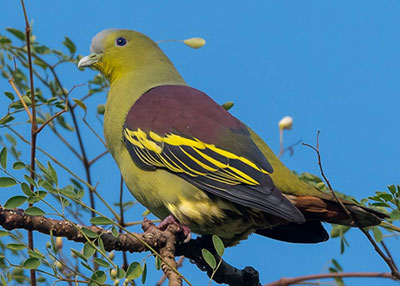
ceylon Green-pigeon - ශ්රී ලංකා බටගොයා
The Ceylon Green-Pigeon, also known as the Sri Lanka Green-Pigeon, is a magnificent bird endemic to Sri Lanka, belonging to the Columbidae family, which includes pigeons and doves. This bird is a true gem of Sri Lanka’s forests, with its vibrant green plumage blending perfectly with the dense canopy of the island’s tropical forests. It is commonly found in lowland rainforests, dry zone forests, well-wooded areas, and even home gardens with sufficient tree cover. While the species is widely distributed throughout the country, it is particularly abundant in protected forest reserves such as Sinharaja Forest Reserve, Horton Plains National Park, and the Knuckles Mountain Range.
The Ceylon Green-Pigeon is primarily arboreal, meaning it spends most of its life high up in the trees, rarely descending to the ground except for drinking water or collecting nesting materials. Their diet consists mainly of fruits, especially figs, berries, and soft fruits, which makes them an essential part of the ecosystem as seed dispersers. By consuming a variety of fruits and later excreting the seeds in different locations, they play a crucial role in forest regeneration and biodiversity maintenance. Their feeding habits also make them important for the survival of many native plants, as they contribute to seed dispersal and germination.
The Ceylon Green-Pigeon is sexually dimorphic, meaning there are slight differences in appearance between males and females. The male has a distinctive maroon-colored mantle on its back, contrasting beautifully with its predominantly green plumage, while the female is entirely green, which provides her with excellent camouflage among the foliage. This color difference is an evolutionary adaptation that helps protect females and their young from predators by making them less conspicuous while nesting. Both males and females have yellowish-green underparts, bright yellow legs, and a pale blue-gray beak with a slight curve at the tip, ideal for plucking fruits. Their eyes are encircled by a thin bluish or yellow ring, adding to their unique and striking appearance. The overall body structure of the Ceylon Green-Pigeon is stout yet agile, allowing it to maneuver effortlessly among branches while foraging. Its wings are broad and rounded, making it an efficient flier capable of covering considerable distances in search of food.
One of the most distinctive features of the Ceylon Green-Pigeon is its soft, rhythmic cooing calls, which echo through the forests. These calls are often described as a series of mellow, whistling coos, which they use for communication, attracting mates, and warning others of potential threats. Their vocalizations contribute to the tranquil atmosphere of Sri Lanka’s woodlands, making them a favorite among birdwatchers and nature enthusiasts. Unlike many other pigeon species, they are generally shy and elusive, preferring to remain hidden among dense foliage rather than venturing into open spaces. However, in areas where they are accustomed to human presence, such as village gardens and small plantations, they may become more approachable.
During the breeding season, which usually occurs between February and May, the Ceylon Green-Pigeon engages in elaborate courtship displays. The male performs aerial acrobatics, puffing up his chest and flapping his wings gracefully to impress the female. Once a pair is bonded, they work together to build a simple, loosely constructed nest, usually placed in the fork of a tree or a dense bush. The nest is made of twigs, leaves, and other plant materials, and although it appears flimsy, it serves its purpose well. The female typically lays one or two white eggs, and both parents take turns incubating them for about 14 to 17 days. After hatching, the chicks are fed a special secretion called "pigeon milk," produced in the crop of both parents, which provides them with essential nutrients for growth. As they develop, the young birds gradually transition to a fruit-based diet before becoming independent. The parental care provided by the Ceylon Green-Pigeon ensures high survival rates among fledglings, contributing to the stability of their population.
Despite being classified as a species of Least Concern by the International Union for Conservation of Nature (IUCN), the Ceylon Green-Pigeon faces several threats that could impact its long-term survival. One of the most significant threats is deforestation, driven by urban expansion, agricultural activities, logging, and the development of plantations. As forests are cleared, these birds lose crucial nesting sites and food sources, forcing them into fragmented habitats where survival becomes increasingly challenging. Additionally, climate change poses a growing threat, as rising temperatures and changing rainfall patterns can affect the availability of fruiting trees, leading to food shortages. Illegal hunting and poaching are also concerns, as pigeons are sometimes targeted for the pet trade or hunted for food in rural areas. Although not as heavily hunted as some other pigeon species, local communities must be educated on the importance of conserving these birds.
Conservation efforts in Sri Lanka have been instrumental in protecting the Ceylon Green-Pigeon and its habitat. Organizations such as the Sri Lanka Wildlife Conservation Society (SLWCS) and the Department of Wildlife Conservation (DWC) work tirelessly to enforce environmental laws and promote awareness about the importance of preserving native wildlife. Several national parks and forest reserves provide safe havens for these birds, ensuring that their populations remain stable. Ecotourism has also played a positive role in conservation, as birdwatchers and nature enthusiasts contribute to local economies, encouraging communities to protect rather than exploit their natural resources. Additionally, afforestation and reforestation projects have helped restore degraded habitats, providing more feeding and nesting opportunities for these birds.
The Ceylon Green-Pigeon is not only ecologically important but also holds cultural significance in Sri Lanka. In traditional folklore, pigeons are often associated with peace, love, and prosperity, and their presence is considered a symbol of harmony in nature. Birdwatchers and photographers are particularly drawn to the Ceylon Green-Pigeon due to its striking colors and serene demeanor. Many nature lovers embark on trips to Sri Lanka’s lush forests in search of these beautiful birds, making them an integral part of the country's rich avian diversity.
If you wish to spot the Ceylon Green-Pigeon in the wild, the best time to observe them is early in the morning or late in the afternoon, when they are most active. Look for them in fruiting trees, where they can often be seen perched motionless while feeding or interacting with other pigeons. Their excellent camouflage makes them difficult to detect, so listening for their distinctive calls can greatly aid in locating them. Carrying binoculars and a good camera can enhance your birdwatching experience, allowing you to appreciate their beauty up close.
In conclusion, the Ceylon Green-Pigeon is a fascinating and essential part of Sri Lanka’s avian biodiversity. With its stunning green plumage, vital ecological role as a seed disperser, and melodic calls, it adds charm and significance to the country’s forests. While its population remains relatively stable, ongoing conservation efforts are crucial to ensure that this beautiful species continues to thrive for generations to come. By preserving its natural habitat, raising awareness about its ecological importance, and promoting sustainable practices, we can protect not only the Ceylon Green-Pigeon but also the delicate balance of Sri Lanka’s unique ecosystems. Whether you are a passionate birdwatcher, a conservationist, or simply someone who appreciates nature’s wonders, the Ceylon Green-Pigeon serves as a reminder of the beauty and interconnectedness of wildlife in Sri Lanka’s rich landscapes.