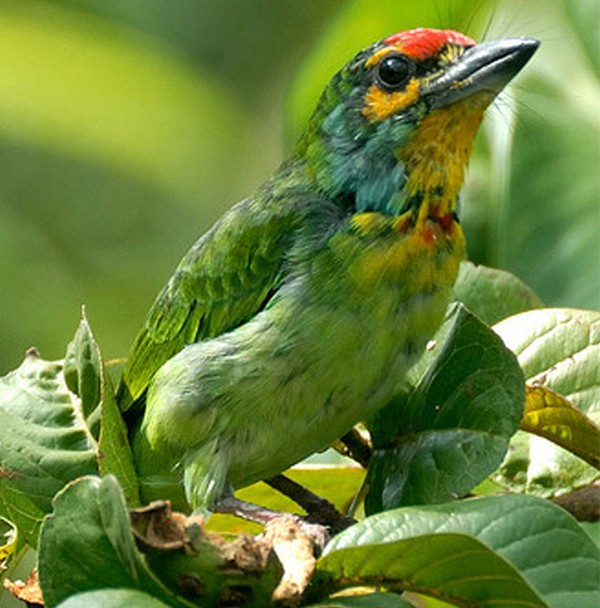
Ceylon Small Barbet - හීන් කොට්ටෝරුවා
The Ceylon Small Barbet (Psilopogon rubricapillus), also known as the Crimson-fronted Barbet, is a beautiful endemic bird species found exclusively in Sri Lanka. It belongs to the Megalaimidae family, which includes barbets—small to medium-sized birds known for their bright plumage, distinctive calls, and strong, stout beaks. The Ceylon Small Barbet is a common but often inconspicuous bird that resides in forests, plantations, gardens, and urban parks across the island. Despite its small size, it is easily recognizable due to its vibrant green plumage, crimson forehead, and characteristic barbet-like call that echoes through the trees.
The Ceylon Small Barbet is a tiny, stocky bird, measuring about 14 cm (5.5 inches) in length. It has bright green feathers covering most of its body, which help it blend into the foliage. The most distinctive feature is its crimson-red forehead and crown, contrasting beautifully with its otherwise green and yellowish plumage. Its throat and breast are streaked with white and brown, while the belly is a lighter green.
The bird has a strong, thick, and slightly curved black beak, perfectly adapted for pecking at tree bark, digging into fruits, and even creating nesting holes in tree trunks. Its eyes are dark with a yellowish ring around them, giving it an alert and curious appearance. The legs and feet are grayish-black, adapted for gripping branches tightly as it moves through the treetops.
As an endemic species, the Ceylon Small Barbet is found only in Sri Lanka and is widespread across the island. It thrives in lowland and montane forests, home gardens, plantations, and even city parks where large trees are present. Unlike some birds that prefer remote forests, this barbet has adapted well to human-modified landscapes and can often be seen in coconut and mango orchards, feeding on ripe fruits.
It prefers open woodlands with scattered trees, where it can perch and scan for food while remaining hidden among the leaves. The Ceylon Small Barbet is also a resident breeder in many of Sri Lanka’s protected areas, including Sinharaja Forest Reserve, Horton Plains National Park, and the Knuckles Mountain Range.
The Ceylon Small Barbet is an omnivore, meaning it eats both plant-based and animal-based food. However, its primary diet consists of fruits, berries, and figs, making it an important seed disperser in Sri Lanka’s forest ecosystems. It particularly favors the fruits of fig trees (Ficus species), mangoes, guavas, and other soft fruits, which it pecks at with its strong beak.
In addition to fruits, it also feeds on insects, larvae, and small invertebrates, using its sharp beak to dig into tree bark and rotten wood. It occasionally catches flying insects mid-air, showcasing its agility and adaptability. The Ceylon Small Barbet often joins mixed-species foraging flocks, where it follows other birds to locate food-rich areas.
One of the most recognizable features of the Ceylon Small Barbet is its loud, repetitive call, which sounds like a "kutroo...kutroo...kutroo" or a "tuk-tuk-tuk" noise. This call is monotonous but continuous, and the bird often sings for long periods, especially during the breeding season.
Its call serves several purposes, including marking its territory, attracting mates, and maintaining contact with other barbets in the area. It is often heard before it is seen, as the bird remains hidden among the leaves while calling loudly.
The Ceylon Small Barbet has an interesting breeding behavior, as it excavates its own nest cavity in tree trunks. Unlike many birds that build nests with twigs and leaves, barbets use their strong beaks to drill small, circular holes in dead tree trunks, coconut palms, or softwood trees.
Breeding usually occurs between January and May, with some pairs nesting again later in the year. The female lays 2 to 4 eggs, which are white and oval-shaped. Both male and female barbets take turns incubating the eggs and later feeding the chicks with a diet rich in fruits and insects. The chicks hatch blind and featherless and depend entirely on their parents for warmth and food.
Once the chicks develop feathers, they practice peeking out of the nest hole before making their first flight. Even after leaving the nest, young barbets stay close to their parents for several weeks, learning how to find food and avoid predators.
The Ceylon Small Barbet is a solitary or small-group species, usually seen alone or in pairs. During the breeding season, it becomes more territorial, often chasing away other birds from its nesting area. However, outside the breeding season, it sometimes joins mixed-species flocks, especially in fruiting trees where multiple bird species gather to feed.
It is an active and restless bird, constantly moving through the treetops in search of food. It spends much of its time hopping between branches, using its strong legs and zygodactyl feet (two toes facing forward and two backward) to grip onto bark while foraging.
The Ceylon Small Barbet is currently classified as a species of Least Concern (LC) by the International Union for Conservation of Nature (IUCN). However, its population is declining due to habitat loss, deforestation, and urbanization. The clearing of forests for agriculture, logging, and human settlements has reduced the availability of nesting trees, forcing the bird to adapt to gardens and plantations.
Despite these challenges, the species has shown resilience and is often found in home gardens and city parks where fruiting trees are available. Conservation efforts such as protecting natural forests, planting fruit trees, and reducing deforestation are crucial to ensuring the long-term survival of the species.
The Ceylon Small Barbet is a fascinating and colorful bird that plays an important role in Sri Lanka’s forest ecosystems. With its vibrant green plumage, crimson forehead, and distinctive call, it is a delight for birdwatchers and nature lovers. Though not currently endangered, habitat destruction poses a serious threat to its survival. Conservation efforts, including preserving forests and encouraging the planting of fruiting trees, can help protect this beautiful endemic species for future generations.