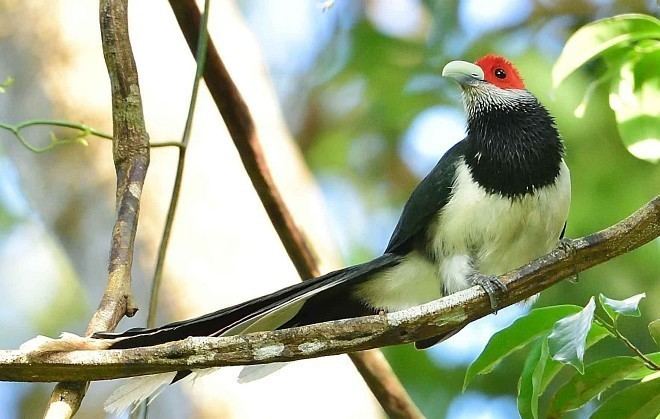
Red-faced Malkoha-ශ්රි ලංකා වත රතු මල්කොහා
The Red-faced Malkoha (Phaenicophaeus pyrrhocephalus) is a striking and
elusive bird species endemic to Sri Lanka, primarily found in the dense
forests of the wet zone and lowland rainforests. This bird belongs to the
cuckoo family (Cuculidae) but differs from typical cuckoos in its
non-parasitic breeding habits. Its most distinctive feature is its bright
red facial skin, which contrasts beautifully with its dark greenish-black
plumage, long tail, and robust, slightly curved beak. This bird measures
around 40 to 50 cm in length, with a long, graduated tail that aids in
balance as it moves through the forest canopy. The iridescent green and
bluish-black feathers on its back and wings make it blend seamlessly with
the foliage, providing excellent camouflage against predators.
The
Red-faced Malkoha is primarily arboreal, meaning it spends most of its
life in trees, skillfully navigating branches with its strong claws and
long tail. Unlike many other cuckoo species, it does not engage in brood
parasitism, meaning it does not lay its eggs in the nests of other birds;
instead, it builds its own nest and raises its young.
This species thrives in primary and secondary forests, particularly in the
rainforests of Sinharaja Forest Reserve, Kanneliya, Kitulgala, and the
lower elevations of the Knuckles Mountain Range. It prefers habitats with
dense undergrowth and tall trees, where it can forage for food safely away
from predators. Although it occasionally ventures into well-wooded home
gardens and rubber plantations, it is rarely seen in open areas or urban
environments. The Red-faced Malkoha is an omnivore, with a diet consisting
of insects, small reptiles, frogs, fruits, and berries. It is particularly
fond of caterpillars, beetles, grasshoppers, and spiders, which it plucks
from leaves and tree bark using its sharp beak. Additionally, it plays a
crucial ecological role in seed dispersal by consuming various fruits and
berries, later excreting the seeds in different locations, thereby aiding
in forest regeneration. This feeding behavior highlights its importance in
maintaining a healthy ecosystem. Observing the Red-faced Malkoha in the
wild requires patience, as it is known for its shy and secretive nature.
Unlike noisy and conspicuous birds, it moves quietly through dense
vegetation, relying on its camouflage to avoid detection. However, its
presence is often revealed by its soft, low-pitched "kok-kok" or
"krow-krow" calls, which it uses to communicate with its mate or signal
alarm when a predator is nearby.
During the breeding season, which typically occurs between March and July,
this species constructs a cup-shaped nest hidden within dense foliage,
often placed high in the trees to protect it from ground predators. The
nest is built using twigs, leaves, and moss, and both parents share the
responsibility of incubating the eggs and feeding the hatchlings. The
clutch usually consists of two to three eggs, which hatch after an
incubation period of about 14 to 16 days. The young birds remain in the
nest for a few weeks before fledging, during which time the parents
tirelessly provide food and protection. Due to its restricted range and
dependence on forest habitats, the Red-faced Malkoha faces several
threats, including deforestation, habitat fragmentation, and human
disturbances. As Sri Lanka continues to experience rapid urbanization and
agricultural expansion, many lowland rainforests have been cleared for
tea, rubber, and palm oil plantations, reducing the available habitat for
this bird. Additionally, illegal logging and forest encroachment pose
significant threats, making conservation efforts critical for its
survival.
The International Union for Conservation of Nature (IUCN) has listed the
Red-faced Malkoha as Near Threatened (NT), indicating that while it is not
yet endangered, its population is declining and requires proactive
conservation measures. To protect this species, several initiatives have
been implemented, including forest conservation programs, eco-tourism
promotion, and reforestation projects. The Sinharaja Forest Reserve, a
UNESCO World Heritage Site, plays a vital role in safeguarding the
remaining populations of the Red-faced Malkoha, providing a protected
environment where it can thrive without human interference. Moreover,
organizations such as the Sri Lanka Wildlife Conservation Society (SLWCS)
and the Department of Wildlife Conservation actively work to enforce
environmental laws and raise awareness about the importance of preserving
native bird species. Birdwatchers and nature enthusiasts visiting Sri
Lanka often seek out the Red-faced Malkoha due to its rarity and unique
appearance. The best chance of spotting one is in the early morning or
late afternoon, when it is most active. A good pair of binoculars,
patience, and a keen ear for its soft calls are essential for successful
observation. As an integral part of Sri Lanka’s biodiversity, this bird
represents the rich avian heritage of the island and highlights the
importance of preserving its natural habitats.
While conservation efforts have helped maintain stable populations in
protected areas, continued deforestation and climate change remain ongoing
threats. Encouraging sustainable forestry practices, promoting
eco-tourism, and increasing awareness among local communities about the
ecological role of the Red-faced Malkoha can significantly contribute to
its long-term survival. In conclusion, the Red-faced Malkoha is a
fascinating and beautiful bird that embodies the rich biodiversity of Sri
Lanka’s rainforests. Its distinctive red facial markings, long tail,
secretive nature, and omnivorous diet make it a key player in the
ecosystem, aiding in both insect population control and seed dispersal.
However, due to habitat loss and human activities, this species is now
facing increasing threats, emphasizing the need for conservation efforts.
By protecting its natural habitat and supporting conservation programs, we
can ensure that future generations will continue to admire and appreciate
the beauty and ecological importance of the Red-faced Malkoha in Sri
Lanka’s forests.